Here, you can download Anki decks that I made while studying Bulgarian.
Anki is a flashcard program for desktop and mobile. It uses spaced repetition to help you memorize things efficiently.
There are two decks:
- Bulgarian (10k notes)
- Extra BG sentences (9k notes)
The cards cover material from A1, A2, and B1, approximately. See the instructions below on how to filter out cards until you’re ready for them.
Each “note” has a front and back, making two “cards” that the program tracks separately. You practice going from English to Bulgarian and from Bulgarian to English for each item.
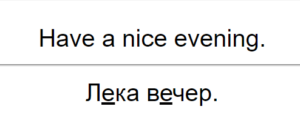
You rate how hard each card was, which will influence how often you review it. For example, if the English-to-Bulgarian card is more difficult, you’ll see it more often.
The cards won’t teach you Bulgarian. They help you review what you’ve learned elsewhere and practice making sentences.
Downloads
- Get Anki. I recommend:
- Get both the desktop and mobile apps
- Sign up for a free Ankiweb account so you can sync between desktop and mobile
- Download the decks:
Bulgarian
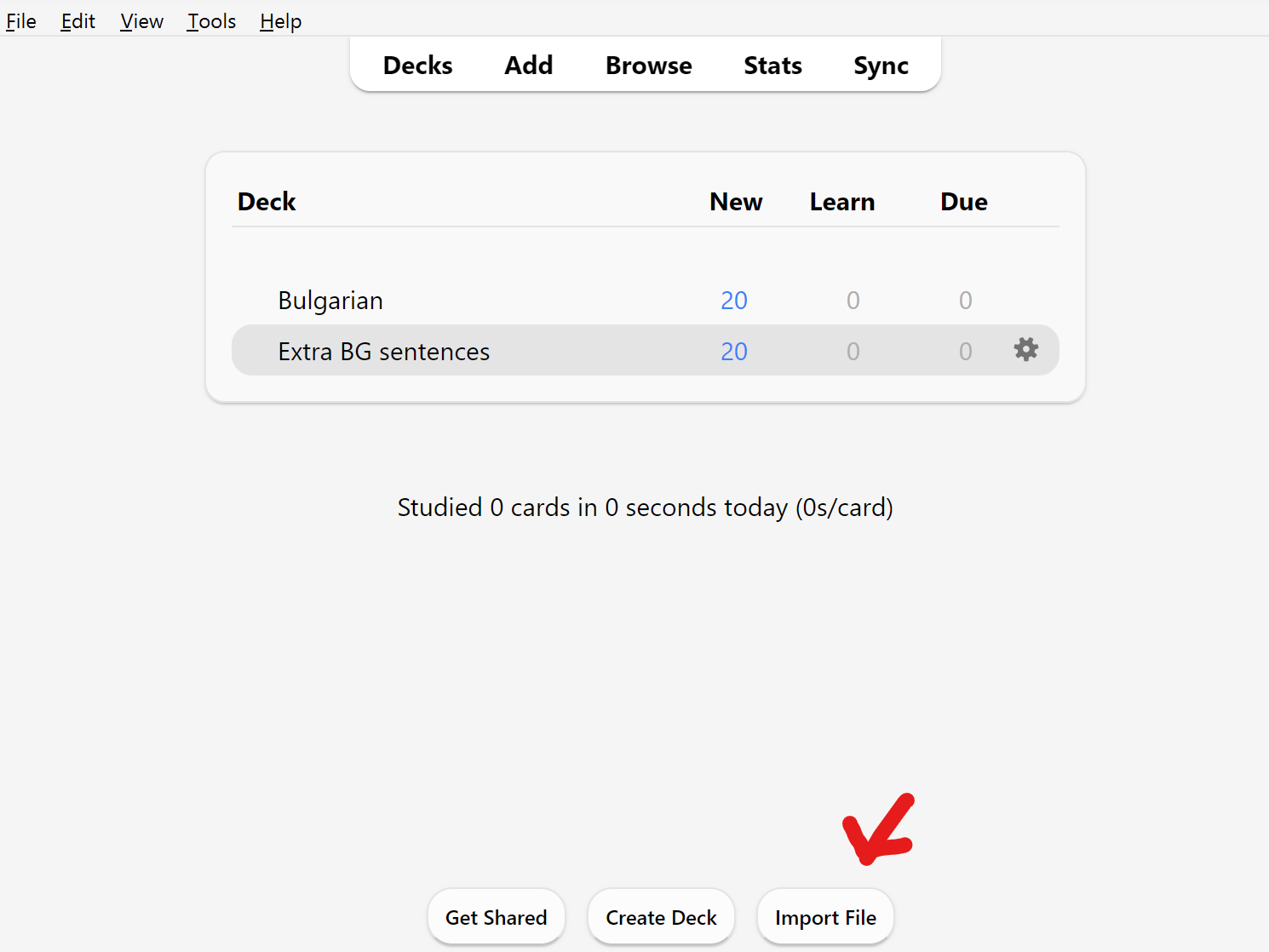
Extra BG sentences - Import them into Anki.
- Check out the other Bulgarian decks available here.
“Bulgarian” deck
This is my main deck for learning. The material comes from from many sources, including:
- The Tatoeba sentence deck described below
- Bulgaro.io (good for learning grammar)
- Речник на българския език
- Wiktionary
- Bulgarian material that I read or watch, like these media and books for Bulgarian learners
- Translations from DeepL
Accuracy isn’t guaranteed, especially for the stuff I looked up with DeepL.
“Extra BG sentences” deck
A big open-source project, Tatoeba, has compiled thousands of sentences in multiple languages. Native speakers write the translations.
This hardworking person did a first pass to clean up thousands of Bulgarian sentences, creating one-way notes that go from Bulgarian to English.
I did a second pass to delete duplicates, remove suspect cards, and tag several of the sentences. I changed the note type so I could study in both directions, Bulgarian > English and English > Bulgarian.
I moved several sentences into the main Bulgarian deck. The remaining ones are in this deck. They’ll give you extra practice once you’ve reached B1 or so.
Levels in the Bulgarian deck
Cards are tagged according to their level and content.
0Beginner
This reviews a handful of very basic terms.
1Level1
This is probably similar to A1 and A2.
Vocabulary includes:
- Everyday verbs
- Everyday objects, family, home
- Lots of food
- Days, months, numbers, dates
- Directions, transport
Grammar:
-
Present tense, such as:
- I’m hungry!
- It’s starting to rain.
- Can I try it on?
- She still loves him.
- I have to find the key.
- I want to get off at the next stop.
- I think you should tell Tom.
-
Possessives
- He likes his dog.
- Is this your cat?
- These aren’t my keys.
- Whose coat is this?
-
Comparisons
- The bear runs faster than me.
- She lives in the tallest building.
- She eats so much chocolate!
-
Basic “to be” in the past
- We were happy.
- The cat was under the bed
- Where were you?
-
Simple past (aorist) and easy combinations
- I ate everything.
- She found a lot of money.
- I had a great time.
- I found out about you and Tom.
- She said it doesn’t matter.
- He told them to stop yelling.
-
“Have to” in the past
- I had to call them again.
- They had to walk to Sofia.
-
Future and “won’t”
- I’ll see him tomorrow.
- How long will it take?
- She’ll probably come.
- There won’t be a festival this year.
- The cat won’t tell me where the dog is.
-
Simple past with future
- She said she would be late.
- I worried that I would get sick.
-
Conjunctions
- I ate too much, so I need bigger jeans.
- She’s always polite, even though she’s crazy.
- I have to pay the bill, otherwise they’ll turn off the electricity.
Higher levels
The following material is in the deck, but it isn’t included in the Level1 tag.
- Imperatives beyond the common “Excuse me” types
- Imperfect past (“She was reading when I got home.”)
- Present perfect (“I’ve seen you here before.”) – this tag is messy, sorry
- Conditionals (“I would never lie to you.”)
- Past perfect, future perfect, etc.
They’re marked with tags. For example, you can study imperatives by focusing on cards that are tagged “imperative.”
Untagged cards
There are lots of cards that I didn’t tag. You could use them for extra practice and tag them yourself.
Verbs
Most Bulgarian verbs have two forms: perfective and imperfective. It was easiest for me to learn both at the same time. All cards tagged “verbs” have this format:
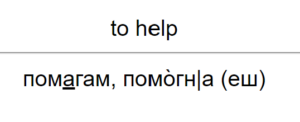
On the left: imperfective “I” form
On the right: perfective “I” form, with the familiar “you” in parentheses
The underscore or accent mark shows which syllable is stressed. I used whatever was handy, which is why there’s no consistency.
The (еш) shows the ти form to remind me how the verb is conjugated in the perfective.
How to study a subset of cards
If you’re at a B1 level or so, you can just start using the cards without filtering any out. But if you’re at a lower level, hide the cards that will frustrate you.
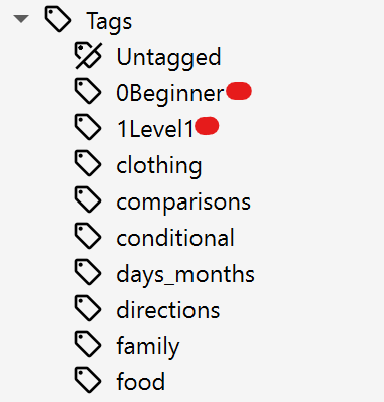
The deck has tags that represent two levels:
- 0Beginner
- 1Level1
You’ll use tags and the “suspend” feature to hide cards you aren’t ready for yet. As you advance, you’ll unsuspend more advanced cards, and your active collection will grow.
1. See only “beginner” cards
On the desktop app, identify the cards that you want to suspend (hide):
-
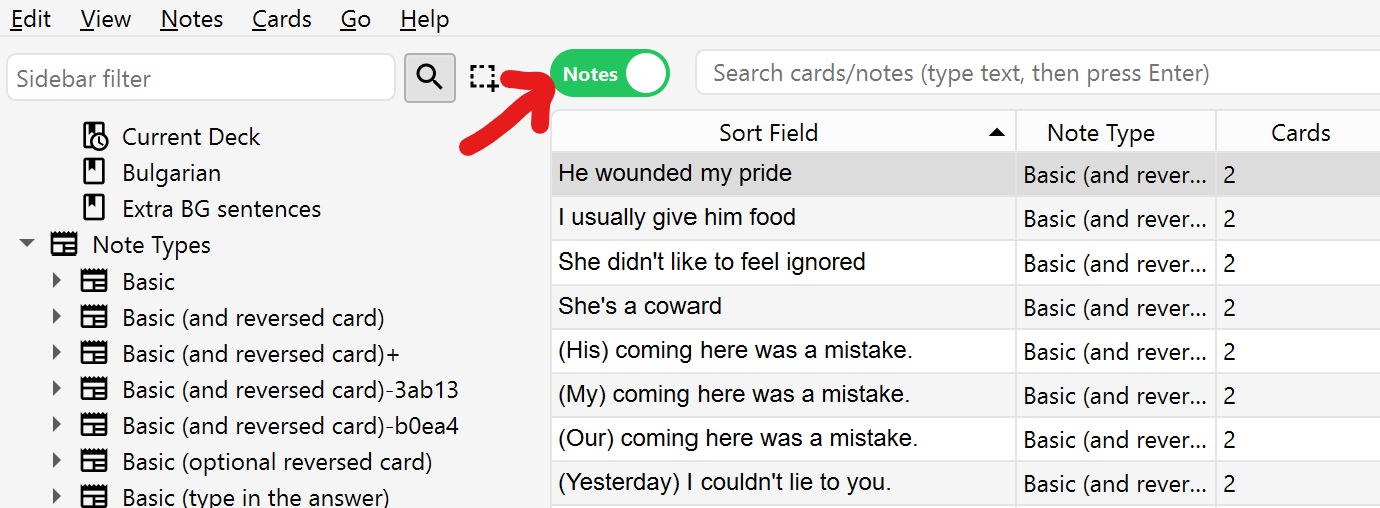
Click browse.
-
Click the slider to go into Notes view.
-
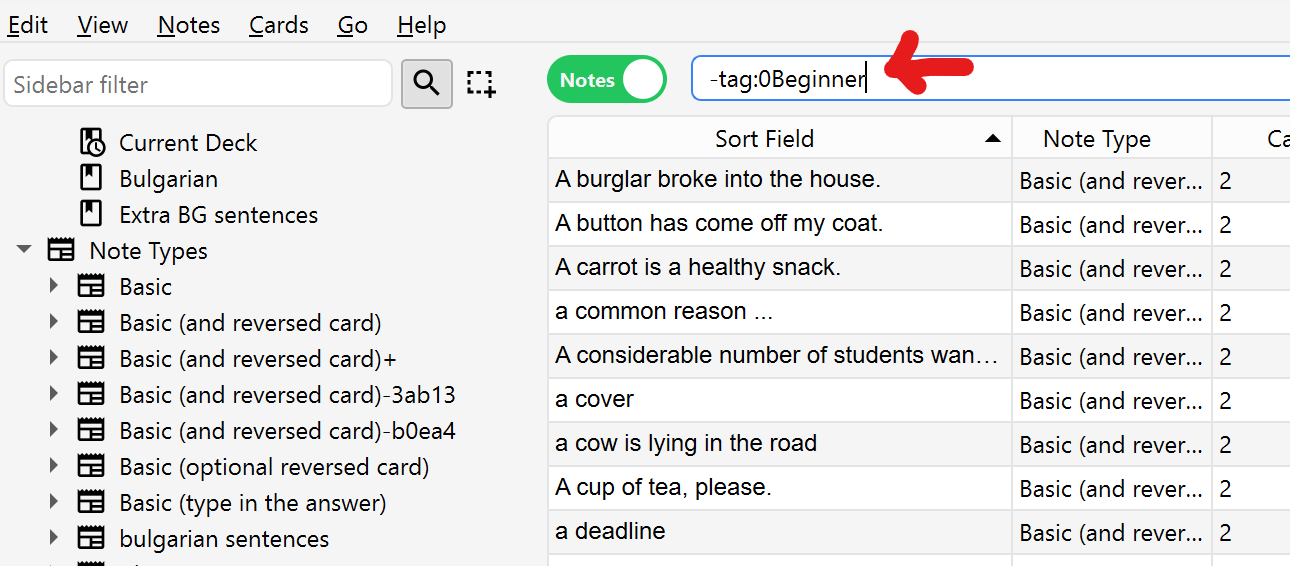
In the search box, enter a search that will show all cards that don’t have the 0Beginner tag. Put a minus sign in front of the tag.
-tag:0Beginner
-
Scroll a bit to make sure that the 0Beginner tag isn’t listed.
-
Select all notes with CTRL-A.
-
In the Cards menu: Click Toggle suspend
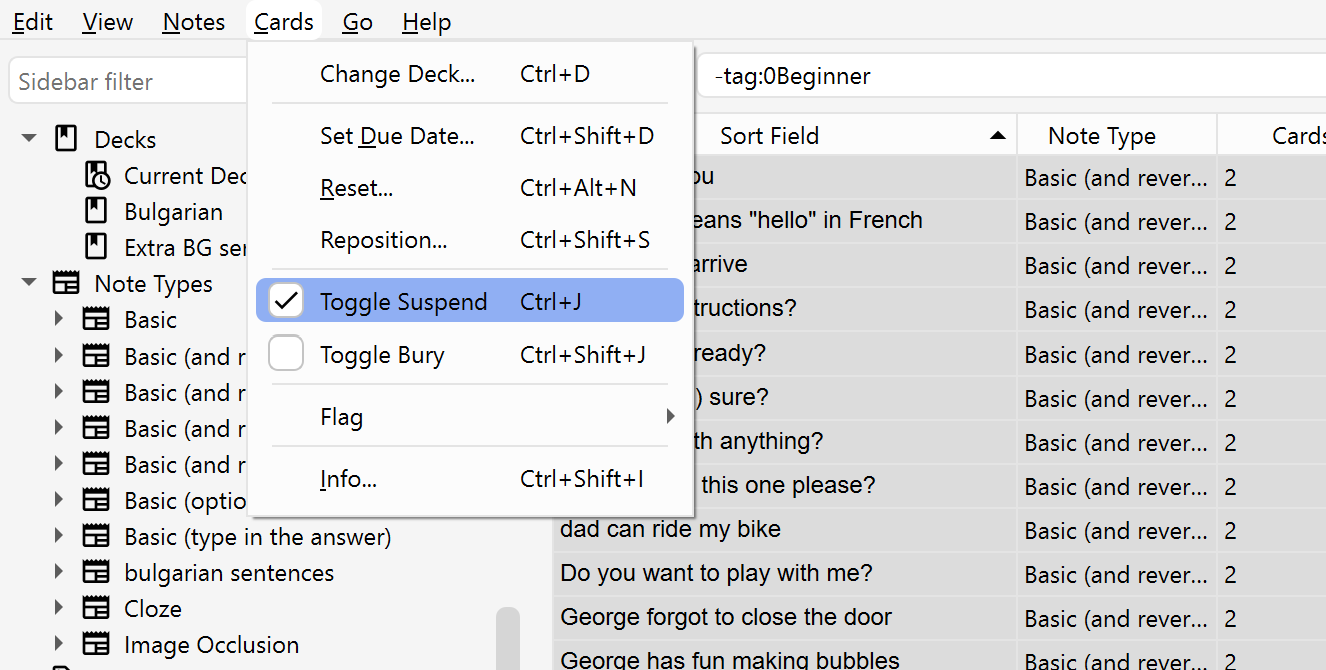
Now all cards in the deck that aren’t tagged 0Beginner are suspended. You won’t see them when studying.
If you switch to the cards view using the slider, you’ll see the suspended cards are yellow.
2. Add levels by unsuspending them
As you progress, unsuspend the more advanced cards to add them to your study sessions.
Add Level1 present tense
You suspended these earlier. Now go to Browse and search for them:
tag:1Level1 -tag:future -tag:past*
Translation: Show all cards that have the 1Level1 tag and NOT the future tag or any tag that starts with “past.”
Select all and click Cards > Toggle suspend to unsuspend them.
This will give you a lot to work with.
Add the future tense
Search for Level1 cards that are in the future tense and unsuspend them.
tag:1Level1 AND tag:future
Add the simple past
Search for Level1 cards that are tagged “past_aorist” and unsuspend them.
tag:1Level1 AND tag:past_aorist
For more search tips, see this Reddit thread.
Study small collections with filtered decks
You can create sub-decks based on a tag to study a smaller subset of cards. Cards are pulled from the main deck and put in a sub-deck.
For example, you can create a filtered deck based on the Food tag.
On the desktop:
- Tools > Create Filtered Deck
- Enter the same search term you would use in the card browser, such as tag:food
Now all the food cards will be pulled from the main deck. When you delete the filtered deck, the cards will return to the main deck, with your progress recorded.
More how-to
Anki manual
Anki forum
Anki sub on Reddit
Tips
Get a quick win: Boost your confidence by learning something that you need every day. For me, that was food. I learned everything in the “food” tag before I learned anything else. That way, I could eat in any restaurant and read any food label.
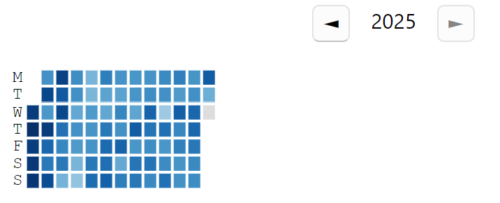
Maintain the streak: Practice a bit every day, and use the calendar in the Stats section of Anki to see your streak.