Here’s how to get a pensioner’s residence permit in Bulgaria. It’s written for US citizens but probably works for other non-EU people. It’s based on research and on my 5 years of experience with my Bulgarian visa.
Because I’m an overachiever, I’ve also listed how to renew your residency, convert it to permanent, and possibly get citizenship.
Not a pensioner? See this overview of all your residency options.
I’m not a lawyer and this could all be wrong.
Check everything with Migration officials or an actual lawyer.
Meet the requirements
For a pensioner’s visa, you’ll need to prove the following. If you’re married and both are retired, it applies individually to each of you, or so I’ve been told.
-
You have a monthly pension from a government. This is usually Social Security but could be from a state or federal agency.
- Possible workaround: I’ve heard of people qualifying with a private annuity that pays monthly.
- Unlikely to be accepted: Investments that you draw from as needed; rental or other passive income that doesn’t come from a government.
-
The pension pays you at least €620 per month (2026). This figure is the current minimum wage in Bulgaria.
- Other sources give other figures, so check this just like you should be checking everything.
- This requirement will increase as the country raises the minimum wage. If your pension is close to the minimum, think twice about Bulgaria, because you might not be able to renew your visa.
-
You have a healthy amount of cash in a bank account that you can easily access from Bulgaria.
- The balance should be at least 12 times the Bulgarian minimum monthly pension. In 2026, the monthly pension is €347.51, so the balance should be at least €4176. Again, check this with Migration or your lawyer.
- Each person in a retired couple should have their own account that meets this requirement, or so I’m told.
- In my opinion, it’s best to have this cash in a Bulgarian bank account. However, different regions seem to have different requirements.
-
You have a clean criminal record.
-
You have a place to live in Bulgaria.
-
You have health insurance that will cover €30,000 of emergency care per year. You can easily buy this in Bulgaria without worrying about pre-existing conditions.
Details vary!
Different Bulgarian embassies and regional Migration offices have different interpretations of the requirements. This isn’t unique to Bulgaria; every visa that I’ve applied for has had this quirk.
Work with the Bulgarian embassy for your current home and the Migration office for the city where you plan to live. Email or call them to find out their requirements, or have your lawyer do it.
Apply from where you legally live
Use the Bulgarian embassy that’s assigned to your current legal residence.
You don’t have to apply from the US if you no longer live there. I applied from Spain, because that was my legal residence.
You’ll get two visas, actually
- Visa D: This gets you into Bulgaria and gives you six months in which to apply for temporary residence.
- Temporary residence visa: You’ll apply using the same documents you used for the visa D. You’ll renew it every year for five years. After that, you can apply for permanent residence.
BASIC STEPS
-
Check your passport’s expiration date.
- Less than 3 years left? Consider renewing it. You’ll soon be applying for repeated one-year visas, and each visa will last only as long as your passport is valid. If your passport expires mid-visa, you face more paperwork.
- US citizens can renew their passport any time, and the renewal is good for 10 years.
-
Visit Bulgaria and:
- Make sure you like it.
- Get lodging + have proof of the lodging notarized (rental contract or deed).
- Get minimal health insurance that will cover at least €30,000/year.
- (Possibly) Get a local bank account + an official bank statement showing your balance.
-
Get an official statement of your pension, such as the Social Security statement of benefits + the appropriate apostille + have it translated.
-
Get a federal criminal records check + a federal apostille + have it translated.
-
As soon as you have your apostilles, make an appointment at your Bulgarian embassy. It won’t be instant.
- The timing matters because your criminal records check will expire in 6 months, and you’ll need it again for the second step in Bulgaria.
-
Get a statement from your bank showing the required cash balance + have it translated, if you didn’t get that in Bulgaria.
-
(Possibly) Have two photos taken for the visa (some embassies take the photos themselves).
-
Complete an application form provided by the embassy.
-
Go to your appointment and submit all of the red documents above for a visa D.
-
Wait 1-3 months.
-
Pick up your visa. It will be stuck to a page in your passport.
-
Go to Bulgaria.
-
Within 6 months of receiving your visa D but ideally a lot sooner, use the same documents as above to apply for one-year temporary residency.
What a lawyer can do
Some of the above can be done for you by a competent lawyer in Bulgaria who knows the pensioner visa requirements for the region you plan to live in.
For example, the lawyer can get health insurance for you and set up a bank account. He or she can coordinate the official translation of your documents and check everything before you submit it.
My lawyer submitted my documents to Migration over email for “pre-approval” before we made the appointment for me to submit them in person.
Don’t choose your lawyer based on price because the cheap “immigration advisors” seem to have caused headaches for some on Facebook.
Of course, if you sign a power of attorney, strictly limit what powers the lawyer has, and give it an expiration date.
DETAILS
Lodging
You’ll need either:
- A long-term rental contract and a statement signed by the landlord in person before a notary, or
- A notarized copy of the deed to a home that you own
Common challenges:
- The landlord doesn’t want to sign a statement saying that you’re renting from them because they’re avoiding taxes.
- Rent only from people willing to sign the statement. The law might change to let landlords say that you’re living there for free, but check this before you commit to anything.
- You plan to live with family or friends.
- My understanding is that this will work, but make sure your lawyer or the notary provides the correct statement.
Possible scams and dubious practices:
- An AirBnB owner signs the statement falsely claiming you live there long term.
- Someone else’s landlord signs a statement saying that you live in the place that they’re actually renting to someone else.
- A scammy agent creates a fake lease and fictional landlord and pays a notary to create the statement.
In addition to being wrong, these practices can cost you your visa because immigration officials can make surprise visits to see if you’re actually living there.
Health insurance
Migration officials require proof that you have emergency coverage to a certain amount (currently €30,000).
This policy is cheap and easy to get. Get it yourself from an insurance office near Migration, or have your lawyer do it. It might cost €100-200 for a year. There’s no exam or concern about pre-existing conditions.
Bank account: Type
Reports vary about whether this account needs to be in Bulgaria. For example, the Bulgarian embassy in Spain let me use a European account for the visa D, but Plovdiv officials required me to get a Bulgarian account for my temporary residency.
My lawyer said that officials in other cities accept foreign accounts for both visa types.
My recommendation: Get a Bulgarian account when you’re visiting. It will be easier to pay local providers, the statement you need for visas won’t need translating, and you can transfer USD into it when rates are good. I was able to get the account with just my US passport.
Either have your pension paid into that account (Social Security will do that) or transfer money from the US using a service like Wise.
Plovdiv Migration hasn’t required me to have my pension paid into a Bulgarian account (though it is anyway). Other sources say that officials do want that and want statements showing the deposits.
The challenge: Banks outside the US don’t want American customers, because the US requires them to file bothersome reports about us. You might have to go to multiple banks with a lawyer or translator to find one that’s willing to let you apply. I had to try 4 banks.
Do this early in your trip, because it can take 2-3 weeks to get your account number, transfer money in, and get the statement for your visa.
Bank account: Statement
From a Bulgarian bank: The statement for Migration can be just a short paragraph on bank letterhead saying that you have an account with the bank and the current balance is €X.
- It should show your full name.
- A bank employee should stamp it and sign it with a blue pen.
- Since it’s already in Bulgarian, you don’t need to do anything else.
From a non-Bulgarian bank: You might see if they’ll provide a signed statement on bank letterhead that shows your full name and says that you have an account with a balance of $X. It will need to be officially translated into Bulgarian.
Some people say they just download and translate a recent monthly statement. I’m not a fan of this because it shows all your transactions to the many people who will see the document, but if Migration accepts it, it’s an easy solution.
Proof of pension
Social Security is a pension in European terms. To get proof of your Social Security income:
- Get an apostille-able Benefit Verification Letter from the Social Security Administration. You might be able to download it from SSA.gov. It can be apostilled if it has an official’s name and signature, even if it’s a digital signature on a PDF, according to this service in DC.
- Get a US federal apostille for it. I recommend using an apostille service (see below).
- An apostille is a separate document that is riveted to the first document. It’s issued by the same level of government that issued the first document. Since the Social Security Administration is a federal office, you need a federal apostille, regardless of what people say on Facebook and what a few confused Migration workers might have approved in the past.
- Have an official Bulgarian translator translate both the apostille and the statement of benefits.
If you live outside the US, you can get a paper SSA letter signed by a human being that you can apostille. You need to go through the US embassy that is responsible for Social Security in your country. See the directory.
Other pension: If you’re using a government pension other than Social Security, the procedure is similar.
- Get an official, signed statement of the amount of your pension from the government office in charge of the pension.
- Have that statement apostilled by the same level of government as the pension issuer. If it’s a state pension, get an apostille from that state.
- Have the apostille and statement translated by an official Bulgarian translator.
Criminal records check
You need a check for the country in which you’ve lived most recently. If you lived there for less than five years, you might also need a check from your previous country.
US resident: You need an FBI Identity History Summary Check. You provide fingerprints at a police station or participating post office, submit them with a form and payment, and later apostille and translate the report.
- Turnaround can (supposedly) be 5 days for electronic prints submitted online and 2-4 weeks for paper prints submitted by mail.
- If you’re outside the US but still a US resident, you can probably take fingerprints at a local police station using special fingerprint forms and send them by mail, or so I’ve heard.
- Consider doing this step almost last. You’ll want to use the same document twice, once for the visa D and then for your residency application in Bulgaria. Migration will reject it if it’s more than six months old. Getting the visa D alone can take 3 months.
Non-US: If you don’t live in the US, you need a federal-level check from the country where you’re legally resident. Procedures and timelines will vary.
- If you’re given the option when ordering the report, say that you need it for a Hague Convention country. If you’re in the EU, you might not need to apostille it; check with Migration or a lawyer.
Getting apostilles
I recommend using an apostille service for US apostilles. I’ve happily used OneSourceProcess several times.
Advantages of using a service:
- You send scans of the documents to the service before mailing them. The service reviews the documents to make sure they can be apostilled, potentially saving you weeks.
- The staff know immediately if there’s an issue at the apostille office, such as a snowstorm or walkout, and can explain how that might affect turnaround time.
- If you’re not based in the US, you avoid the immense hassle of having to provide a check and self-addressed, stamped envelope. Instead, you pay online and send the documents using a courier like DHL.
Turnaround times
Getting a Bulgarian bank account and statement:
- Possibly 3 weeks to apply, get accepted, get the account number, transfer money in, and get the bank statement for your visa
Social Security benefits letter:
- In the US: If it’s true that you can now download the appropriate signed PDF, then it’s basically instant. I have no experience with this.
- Outside the US: You’ll work with the US embassy that’s assigned to handle SSA for your region. For me, that’s the embassy in Athens. It takes about 4 weeks to get the letter in Bulgaria. (I was living in BG with another visa when I switched to pensioner.)
FBI check, as of late 2026:
- Electronic prints submitted online: 3-5 business days
- By mail: 2-4 weeks
Criminal records check from other countries: Varies widely. I got an apostilled report from Spain entirely online in three days; a report from Mexico for another visa took a week and two personal visits.
US apostilles:
- OneSourceProcess currently (late 2026) lists 10 business days as turnaround for federal apostilles. Add the time it takes to send the documents in both directions.
Translation by an official translator:
- Allow at least 3 days per document + shipment time
Getting an appointment to submit documents:
- People in the US have recently mentioned waiting a month for an appointment.
- I waited about two weeks for the embassy in Valencia, Spain.
Visa D processing after submission:
- 1-3 months seems common lately
In Bulgaria: Apply for temporary residency
Your Visa D gets you into Bulgaria. Next, you’ll use the same documents to apply for temporary residency at the Migration office for the region where you live.
Some tips:
- Don’t delay. Your criminal records check is good for only 6 months after it was issued.
- Bring a Bulgarian lawyer or translator. In my experience, most Migration workers speak only Bulgarian.
- Prepare to say goodbye to your apostilled Social Security document. Migration used to return it so you could use it again the following year, but in my experience, they seem to have stopped this.
In Plovdiv, at least, you’ll make three visits.
Visit 1: Submit the same documents you used for the Visa D: criminal records check, pension letter, bank statement, proof of lodging, health insurance.
- You might have to renew or extend your health insurance: It needs to be valid for the next 12 months.
- You’ll also need to complete a form. Your lawyer should have it, or there are probably small offices near Migration that can complete it for you.
- Bring a copy of the first page of your passport and every page that has a stamp (at least, I had to do that).
- If you’re submitting a copy of your property deed, also bring the original. In my experience, Migration staff don’t seem to believe the copy.
- The Migration worker will examine your documents. If she accepts them without changes, your application has probably been accepted, and you won’t receive any notification.
- Migration staff will probably tell you to come back in two weeks.
Visit 2, two weeks later: Pay the fees.
- Bring your passport and a copy of its ID page.
- Pay the fee for your visa, using a card or (probably) cash.
- You’ll be given a form that collects details for your ID.
- Leave the desk and have a Bulgarian help you complete the form, then bring it back into Migration.
- They’ll charge you another fee for printing your card. The fee depends on how quickly you want the card to be processed.
- Staff will take your photo and fingerprints.
- They’ll give you a tiny slip of paper that you’ll need to pick up your card.
Visit 3, about a week later: Pick up your card.
- Depending on the processing time you chose, go back to Migration with the little slip of paper and collect your card.
- You’re done for the next 9 or so months.
Less than 1 year later: Renew your residency
Technically, you should submit your renewal at the latest two weeks before your card expires, but it’s best to do it sooner in case of surprises.
You’ll need the same documents you had before except the criminal records check.
- If Migration didn’t return last year’s Social Security document, get a new one apostilled and translated. Otherwise, you can submit the previous year’s document, in my experience.
- Renew your health insurance for another year and get proof of that.
- Get another statement from your bank showing your balance.
- Get another notarized statement from your landlord or bring your original deed and a copy.
- Photocopy the first page of your passport and all pages that have stamps (sometimes Migration staff want this, and sometimes they throw it away; it’s a mystery).
- Photocopy both sides of your ID card.
Social Security statement
The main hassle will be your Social Security benefits letter. If Migration returned it to you last year, you can probably use it again. If they didn’t return it, start getting a new one at least three months before your renewal.
Since you now live in Bulgaria, you get your benefits letter from the US Embassy in Athens. (It might also be possible to download it from SSA.gov, but not in my experience.)
- You request it through email, but they send it through conventional Greek and Bulgarian post, so allow at least a month to receive it.
- Send it via DHL to a US apostille service. My turnaround for that is usually 3-4 weeks.
- Add another week for translation, and the total turnaround is about two months.
- I’ve had some issues with delays at Athens (no response to my emails), so three months is safer.
Then the process is the same as your previous application: 3 visits to Migration to get a new card.
Repeat this every year. Each time you renew, Migration staff will make a note inside the back cover of your passport. This keeps track of how many years you’ve been here.
Never miss your renewal date. Trying to renew even a few days past the expiration date could break the 5 years of continuous residence required to qualify for permanent residency.
- If you don’t have all your documents by the deadline, submit what you have. Staff will give you an extension, and you’ll avoid a fine and risk to your permanent residency.
5 years later: Permanent or long term residency
After 5 years as a temporary resident, you can apply for one of the following:
- Permanent residency: For Bulgaria only. It never expires; you just need to replace the physical card every five years to update your address or biometrics.
- Long term residency: Applies to the EU and makes it easier to move to another EU country. However, you have to reapply with financial proof and everything else every five years.
Qualifications depend partly on how long you’ve been gone from Bulgaria.
- Permanent BG residency: You must not have been absent from the country for more than 30 months in the last 5 years.
- Long term EU residency: You must not have been absent from Bulgaria for more than 10 months in the last 5 years and for less than 6 consecutive months.
After 5 years in either category, you can apply for Bulgarian citizenship.
Consider renewing your passport before applying.
To keep your Migration visits to a minimum, you might renew your passport before you apply for permanent residency. Otherwise, your residency period will be limited to the amount of time left on your passport.
You can renew it in Bulgaria by completing an unusual number of online forms and sending it to the US Embassy in Sofia. See these instructions.
You’ll receive your old passport along with the new one. Keep the old one; it has stamps and annotations that you’ll need for your permanent residency application.
Apply early
You’re required to apply for permanent residency at least 2 months before your current residency expires. Migration staff told me it’s better to aim for 3 months.
I’m still researching this and have asked Migration for details. So far, the best source of information seems to be this guide from Melssa.
As far as I know, you’ll need:
- A criminal records check from Bulgaria, since that’s where you’ve been living. It isn’t clear to me if you have to provide it or the immigration authorities look it up themselves.
- Possibly also a criminal records check from another country if you have spent significant time there.
- Some sources say you need a records check from your country of citizenship, but that seems bizarre since you’ve been living in Bulgaria for the last 5 years. Did you rush back to the US to commit a crime since your last check?
- Some amount of health insurance, or possibly none since you now can join the national plan
- The usual proof of lodging
- Proof of financial stability: Migration staff told me I no longer have to provide the Social Security benefits letter, just a bank statement. However, I don’t know how much of a balance they want to see; I assume it’s more than the usual renewal amount.
- A declaration of absences that apparently details how much time you’ve spent outside Bulgaria.
- Possibly: Copies of boarding passes or other documents if there’s a chance Migration will think you haven’t spent the minimum required time in Bulgaria.
- A form that apparently asks for strange details about family members that don’t live with you
- Possibly other things; I’m just starting this process.
After another 5 years: Apply for citizenship
After 5 years on permanent or long-term status, you can apply for Bulgarian citizenship. You don’t have to; you can stay forever on permanent.
According to this site and other sources, you’ll need:
- A clean criminal record in Bulgaria
- Evidence that you can support yourself, such as proof of your pension
- Your birth certificate, apostilled and translated
- Proof of lodging
- A certificate showing you passed the written language exam
- Try a sample exam
- An interview in Bulgarian
Processing can take 1-2 years.
Once you have Bulgarian citizenship, you’re required to renounce your American citizenship unless you’re married to a Bulgarian citizen or are of Bulgarian origin.
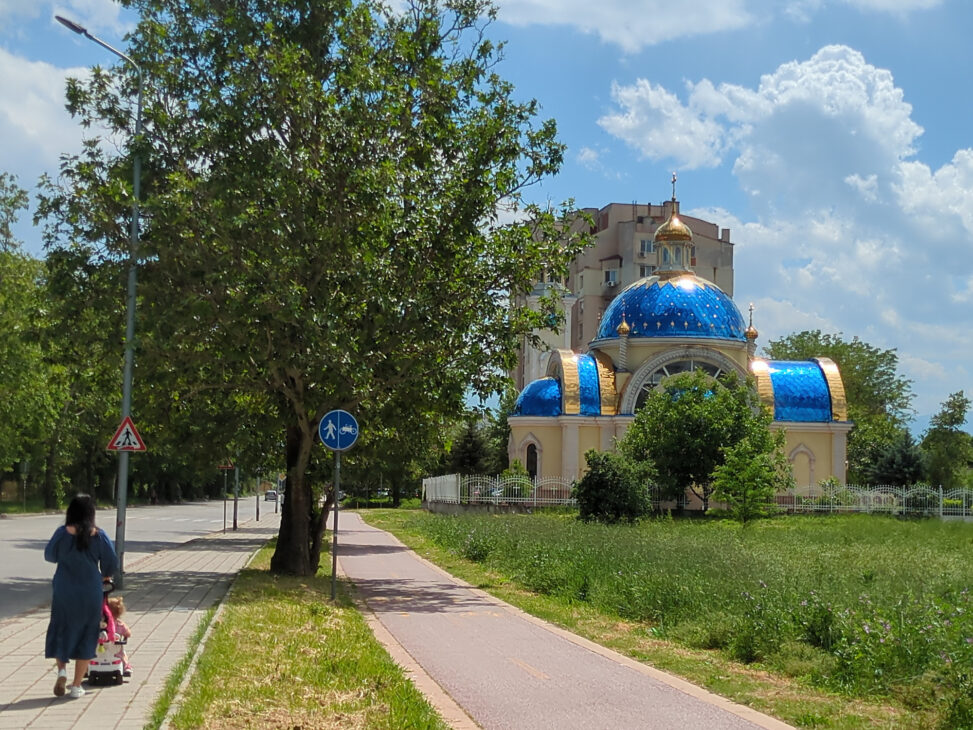
Photo: Sveti Nikolay Mirlikiyski church, Plovdiv